
Role
UX Designer · Self-Initiated
Timeline
2025 · Abu Dhabi
FOOD & DELIVERY
UX CONCEPT
Mobile
order food.
not anxiety.
order food.
not anxiety.
16% of UAE adults live with diabetes. Most order food delivery 3 to 5 times a week. A concept exploring how Talabat could surface health guidance at the moment of decision, without slowing the ordering experience down.
16% of UAE adults live with diabetes. Most order food delivery 3 to 5 times a week. A concept exploring how Talabat could surface health guidance at the moment of decision, without slowing the ordering experience down.
↑
UAE adults living with diabetes, the primary user this feature is designed for.
UAE adults living with diabetes, the primary user this feature is designed for.
CONTEXT
↑
UAE residents who use food delivery apps regularly, many as their primary meal source.
UAE residents who use food delivery apps regularly, many as their primary meal source.
CONTEXT
↑
Existing healthy mode implementations studied in competitor research before a single screen was designed.
Existing healthy mode implementations studied in competitor research before a single screen was designed.
RESEARCH
↑
Of Zomato orders now come from Healthy Mode, market proof the demand is real.
Of Zomato orders now come from Healthy Mode, market proof the demand is real.
VALIDATION
FINAL design
guessing → ordering with confidence.
guessing → ordering with confidence.
01 · Context
everyday habits with hidden health consequences.
everyday habits with hidden health consequences.
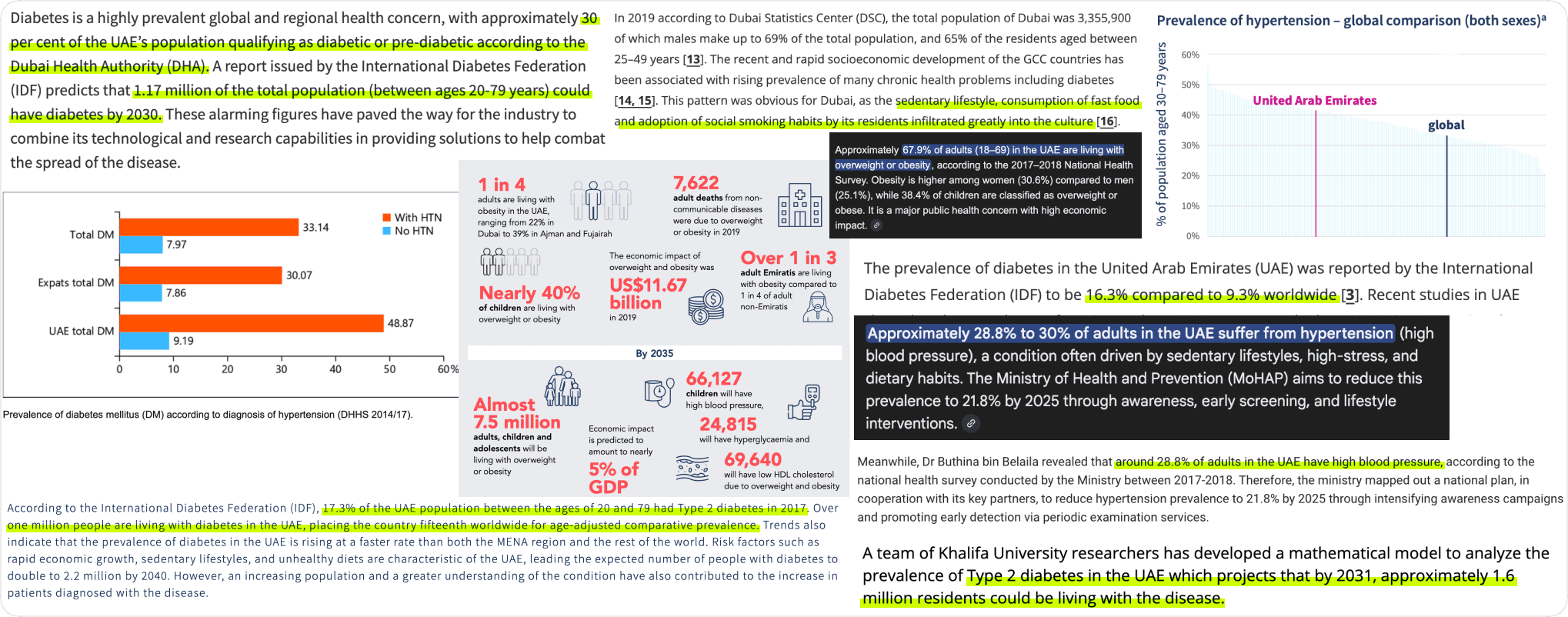
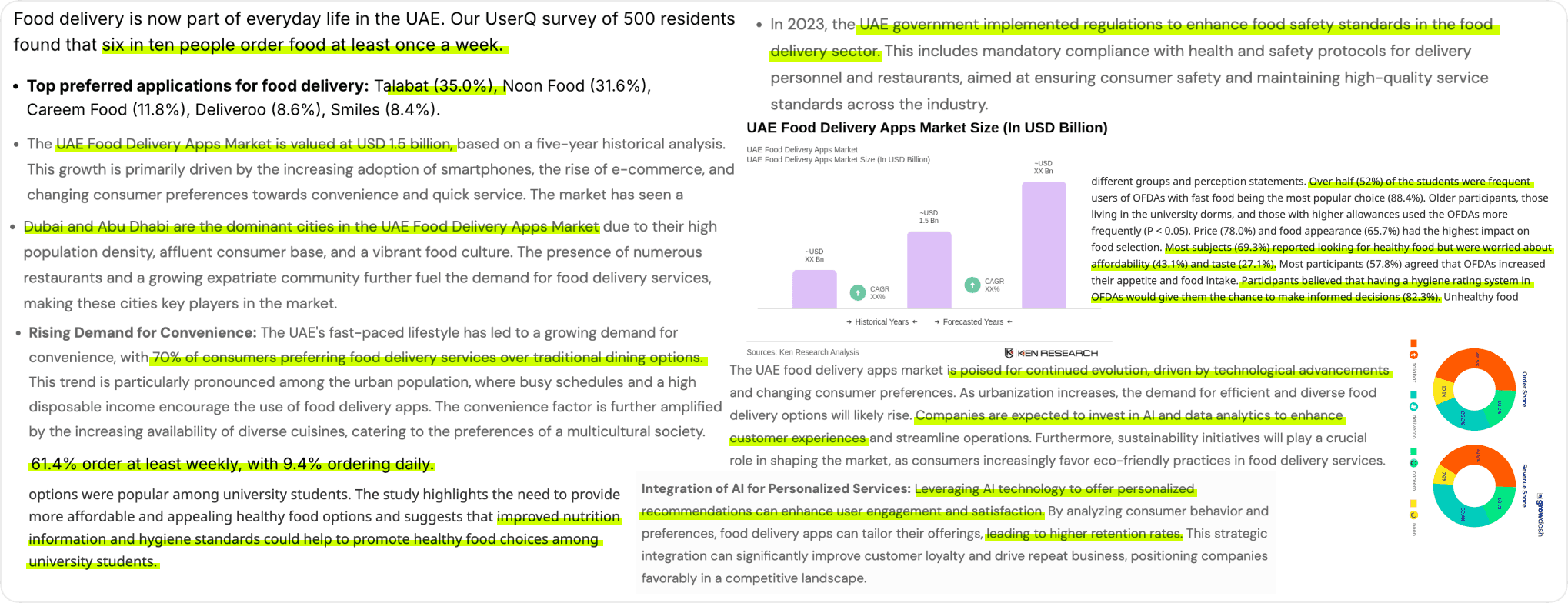
Food delivery has become the primary source of meals for millions of UAE residents. People order 3 to 5 times a week, often on autopilot. At the same time, the UAE has one of the highest rates of diabetes, hypertension, and obesity in the world.
Food delivery has become the primary source of meals for millions of UAE residents. People order 3 to 5 times a week, often on autopilot. At the same time, the UAE has one of the highest rates of diabetes, hypertension, and obesity in the world.
Menus tell you what something costs. They rarely tell you what it does to you.
Menus tell you what something costs. They rarely tell you what it does to you.
02 · Problem
the menu tells you what to eat. not what it does to you.
the menu tells you what to eat. not what it does to you.
01
no ingredient clarity
no ingredient clarity
Menus rarely show full ingredients, sugar content, or allergen information. Users make decisions with almost no visibility into what they are actually eating.
Menus rarely show full ingredients, sugar content, or allergen information. Users make decisions with almost no visibility into what they are actually eating.
02
generic health labels
generic health labels
Healthy badges exist but mean nothing specific. A dish flagged as High Protein can still be high in sugar and sodium. Labels create false confidence.
Healthy badges exist but mean nothing specific. A dish flagged as High Protein can still be high in sugar and sodium. Labels create false confidence.
03
no personalization
no personalization
The app has no idea if you are diabetic, allergic, or watching your sodium intake. Everyone is treated the same, regardless of health context.
The app has no idea if you are diabetic, allergic, or watching your sodium intake. Everyone is treated the same, regardless of health context.
04
friction or nothing
friction or nothing
Users either take risks with every order or avoid food delivery altogether. There is no middle ground that helps them order with confidence.
Users either take risks with every order or avoid food delivery altogether. There is no middle ground that helps them order with confidence.
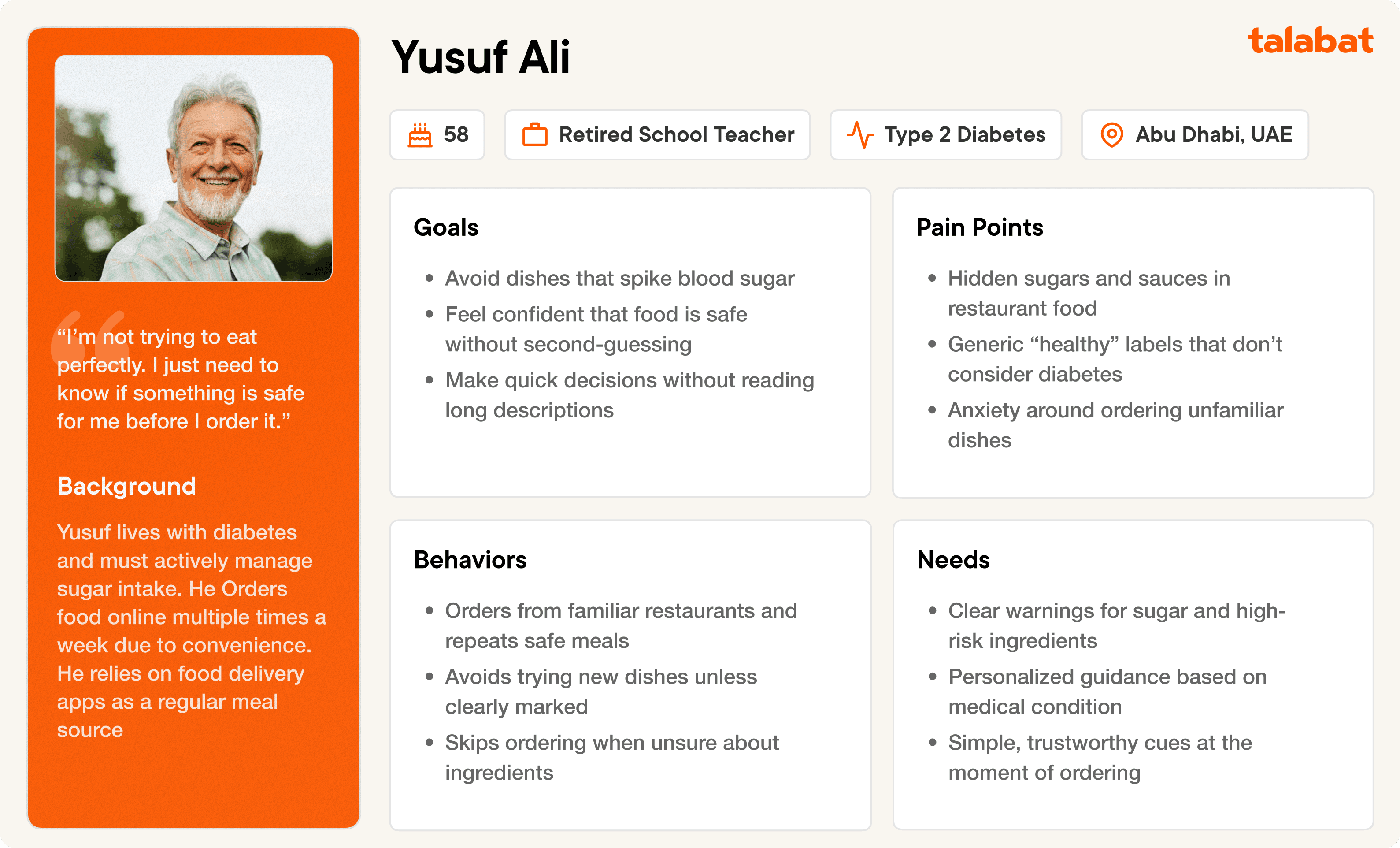
“
the signal · DESK RESEARCH + COMPETITOR ANALYSIS
"I just skip dishes I'm not sure about and hope the rest is fine."
"I just skip dishes I'm not sure about and hope the rest is fine."
DIABETIC USERS
ALLERGY-CONSCIOUS USERS
HEALTH-AWARE USERS
Uncertainty, not unhealthy food, is what stops people from ordering confidently.
Uncertainty, not unhealthy food, is what stops people from ordering confidently.
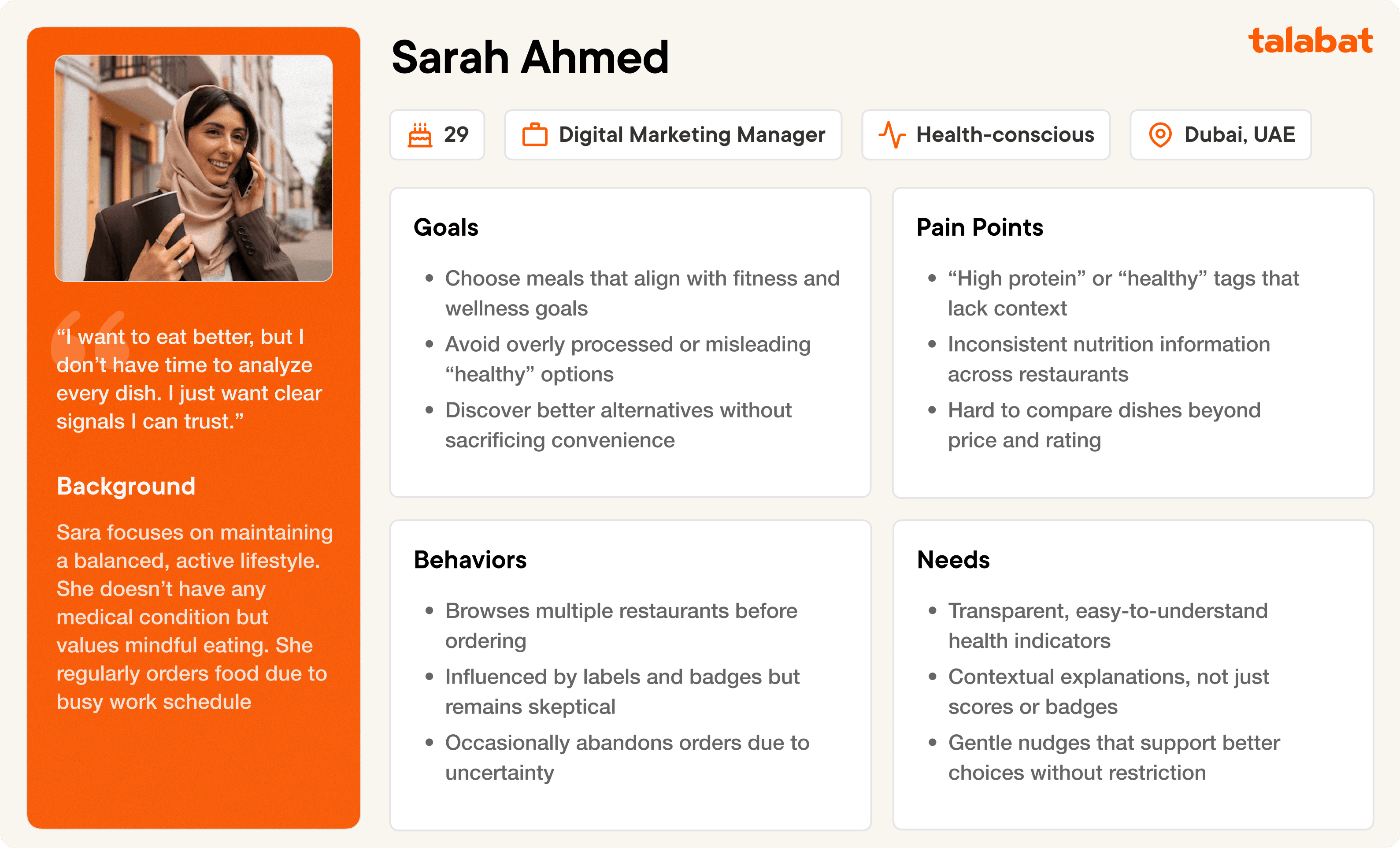
03 · Research
the data confirmed the tension.
the data confirmed the tension.
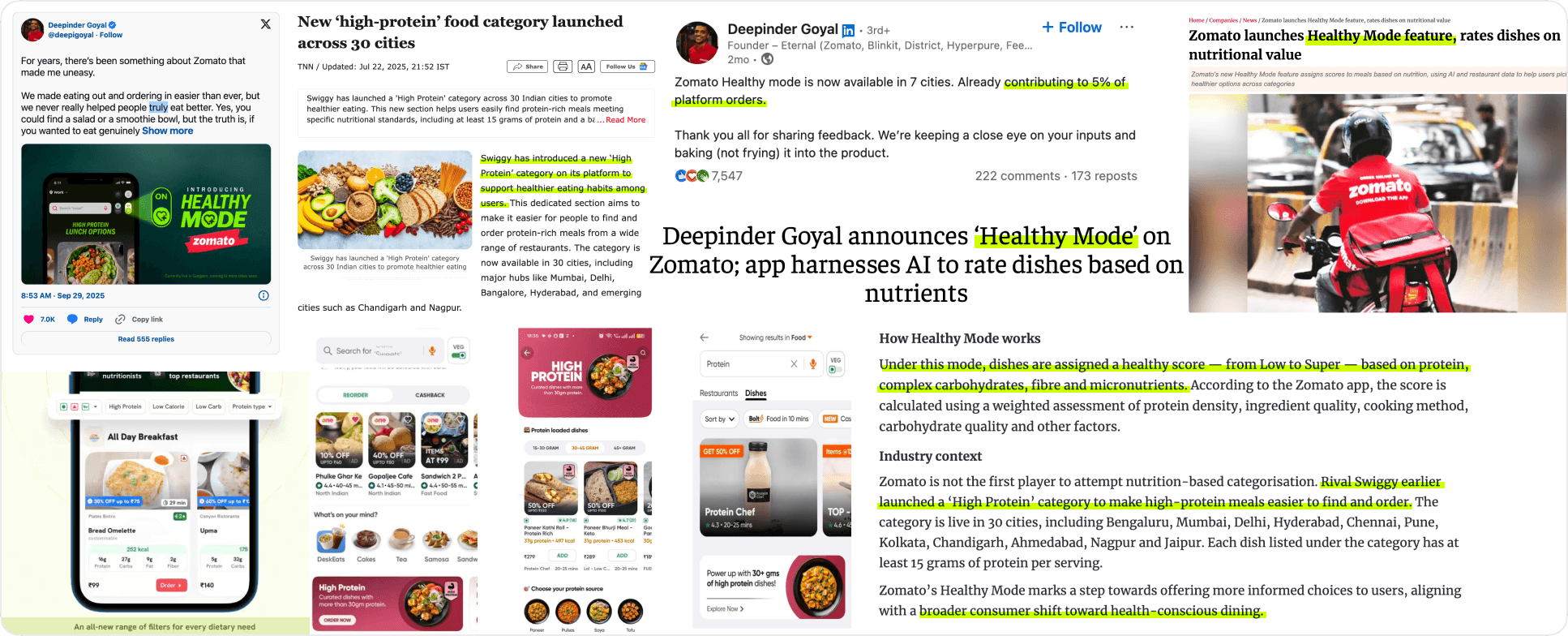
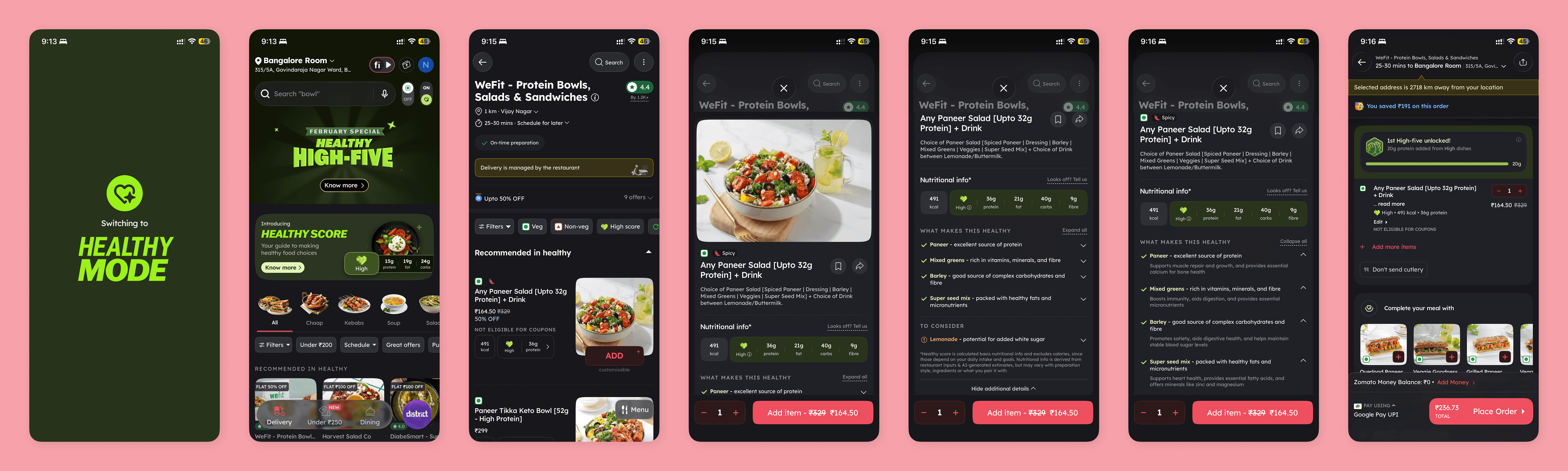
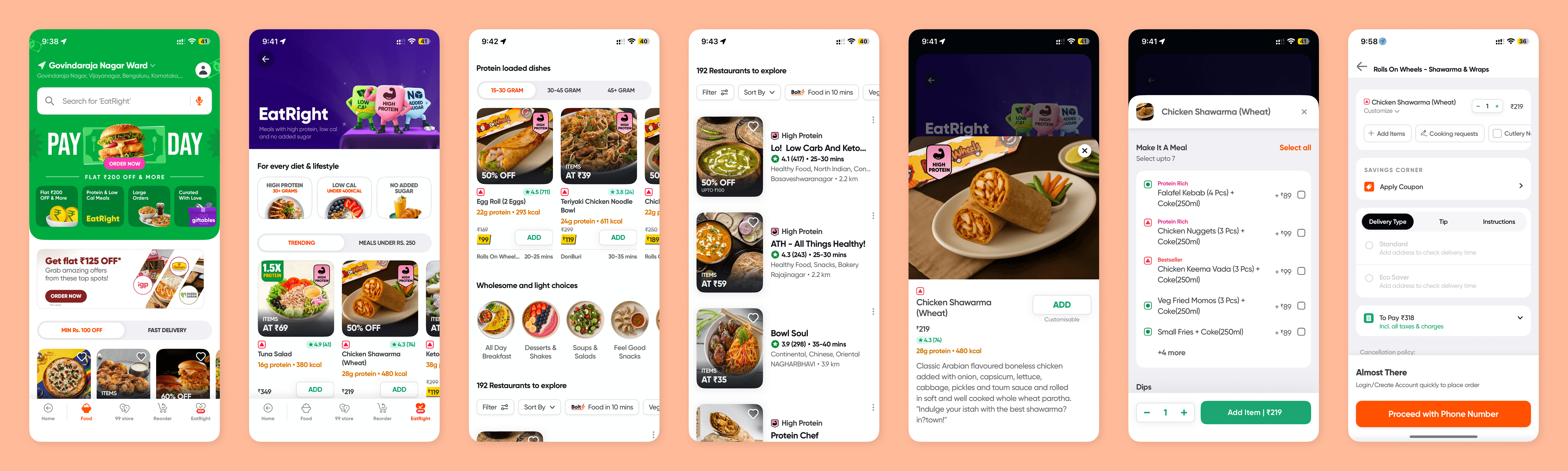
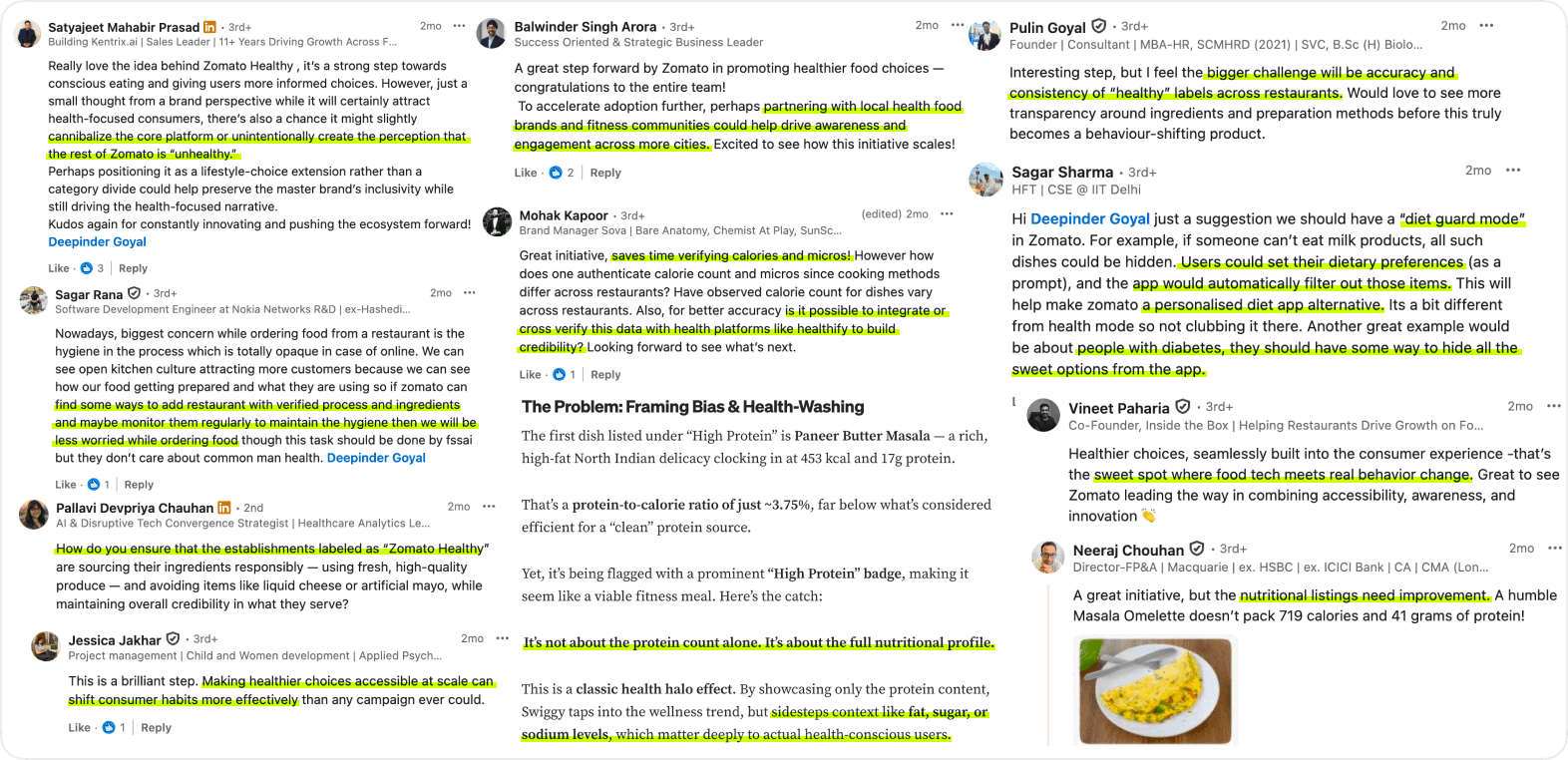
Desk research, UAE health statistics, and a deep audit of Zomato Healthy Mode and Swiggy Eat Right revealed one consistent pattern. The demand for health guidance inside food delivery is real and growing. But existing implementations fall short in the same ways: labels without context, single metrics that mislead, and features designed for one generic definition of healthy rather than the user's specific situation.
Desk research, UAE health statistics, and a deep audit of Zomato Healthy Mode and Swiggy Eat Right revealed one consistent pattern. The demand for health guidance inside food delivery is real and growing. But existing implementations fall short in the same ways: labels without context, single metrics that mislead, and features designed for one generic definition of healthy rather than the user's specific situation.
WHAT THE RESEARCH SURFACED
"I just skip dishes I am not sure about and hope the rest is fine."
"I just skip dishes I am not sure about and hope the rest is fine."

Imran K.
Diabetic user
"Healthy labels exist but I do not trust them. High protein can still spike my sugar."
"Healthy labels exist but I do not trust them. High protein can still spike my sugar."

Sara M.
Health-conscious user
"I want to order with my family but I am always the one holding everyone up while I check every ingredient."
"I want to order with my family but I am always the one holding everyone up while I check every ingredient."

Layla S.
Allergy-conscious user
Competitor analysis · UAE health data · User behavior patterns · June 2025
04 · The BET
healthy mode should feel like a friend, not a doctor.
healthy mode should feel like a friend, not a doctor.
The obvious move is to build a nutrition dashboard: calorie counters, macro breakdowns, red warning alerts. But someone ordering food at 7pm does not want a health intervention.
The obvious move is to build a nutrition dashboard: calorie counters, macro breakdowns, red warning alerts. But someone ordering food at 7pm does not want a health intervention.
They want to feel confident that what they are ordering will not hurt them.
They want to feel confident that what they are ordering will not hurt them.
So the entire feature was scoped around one thing: reducing uncertainty at the moment of decision, not changing behavior.
So the entire feature was scoped around one thing: reducing uncertainty at the moment of decision, not changing behavior.
existing apps treat health as a separate category
existing apps treat health as a separate category
a layer that lives inside your normal ordering flow.
a layer that lives inside your normal ordering flow.
Healthy Mode works because it does not ask users to change how they order. It makes what they already do feel safer.
Healthy Mode works because it does not ask users to change how they order. It makes what they already do feel safer.
05 · Process
designed around the moment of uncertainty.
designed around the moment of uncertainty.
the bet
Every decision went back to the same question: does this reduce uncertainty at the moment the user is deciding what to eat? If not, it did not belong in the feature.
Every decision went back to the same question: does this reduce uncertainty at the moment the user is deciding what to eat? If not, it did not belong in the feature.
01
map the problem space
map the problem space
Analyzed UAE health data, food delivery usage patterns, and the tension between daily delivery habits and diet-related health conditions before touching a single screen.
Analyzed UAE health data, food delivery usage patterns, and the tension between daily delivery habits and diet-related health conditions before touching a single screen.
02
audit the competitors
audit the competitors
Deep-dived into Zomato Healthy Mode and Swiggy Eat Right to identify what they got right and where they created misleading health signals. The gap analysis shaped the design principles.
Deep-dived into Zomato Healthy Mode and Swiggy Eat Right to identify what they got right and where they created misleading health signals. The gap analysis shaped the design principles.
03
define the design principles
define the design principles
Opt-in, not opt-out. Non-blocking. No medical jargon. Plain language. The user stays in control at every step. These four rules governed every screen decision.
Opt-in, not opt-out. Non-blocking. No medical jargon. Plain language. The user stays in control at every step. These four rules governed every screen decision.
04
design flows & prototype
design flows & prototype
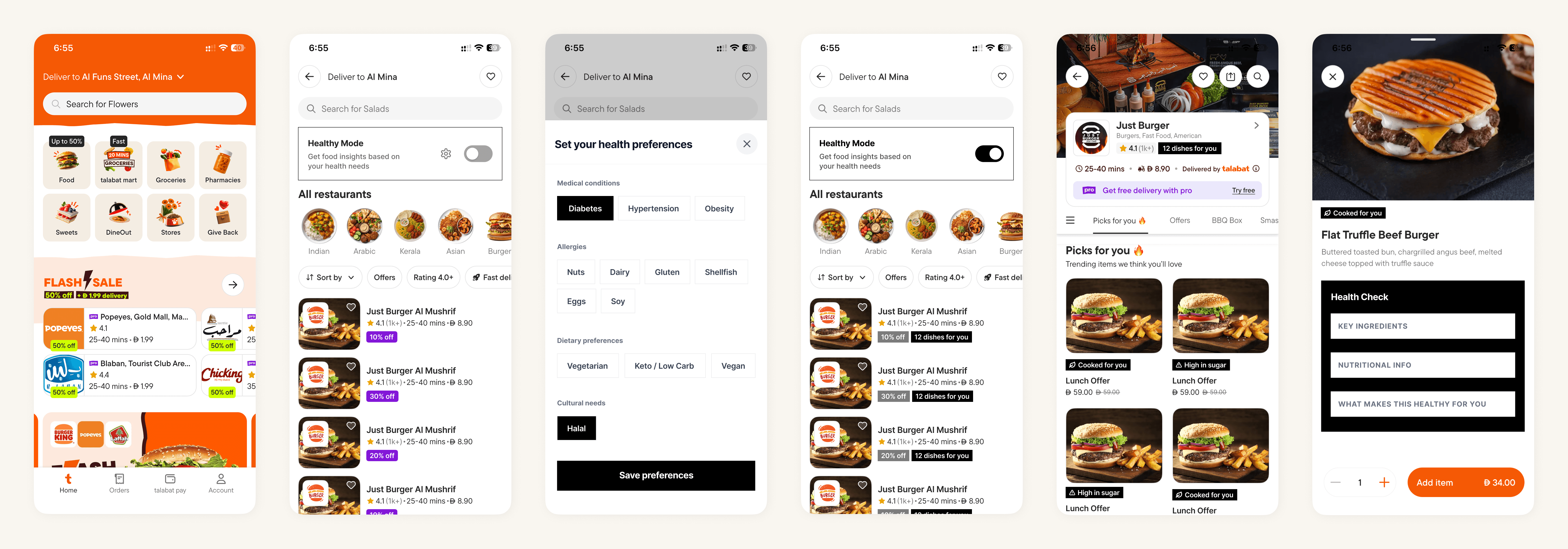
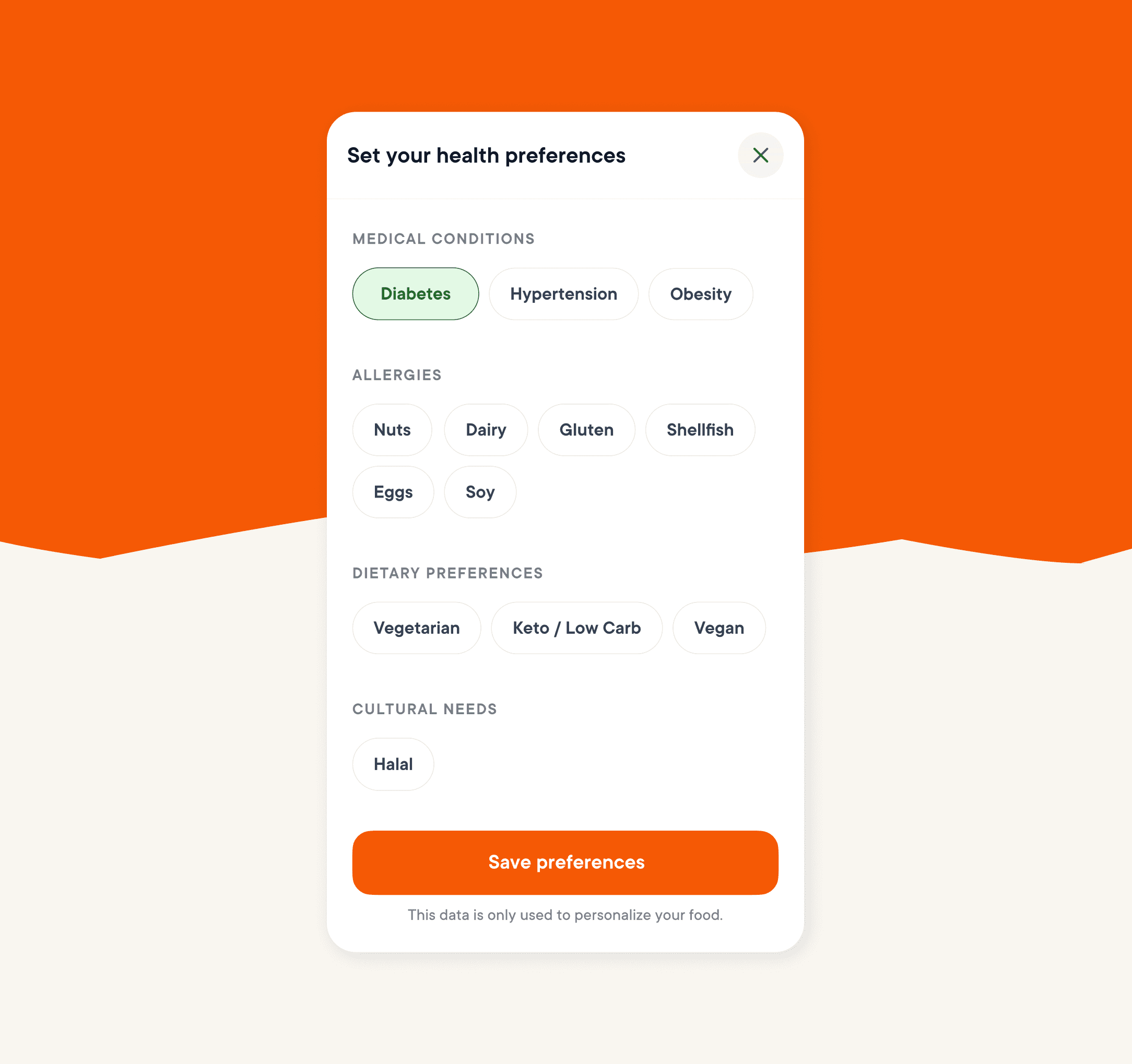
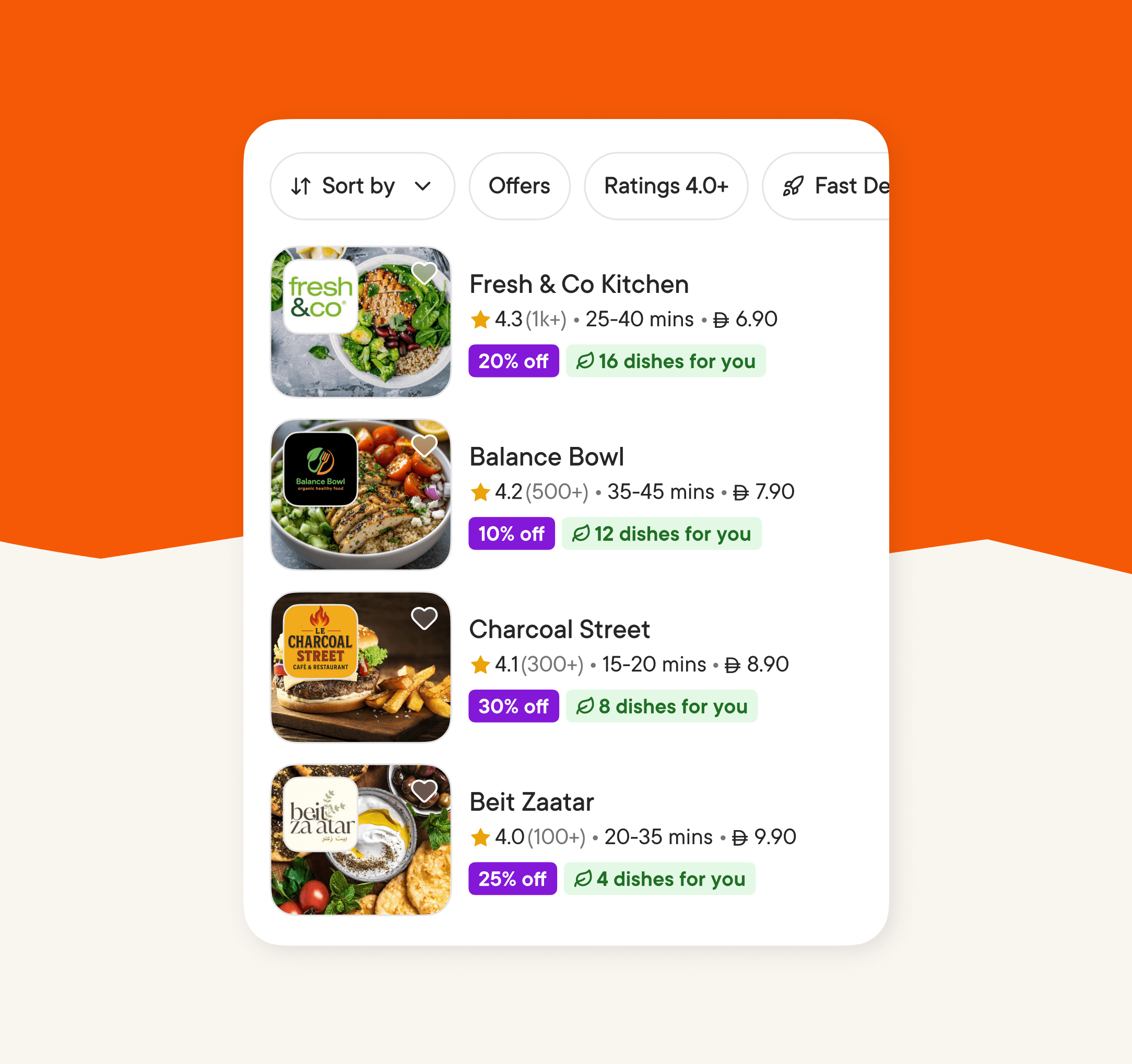
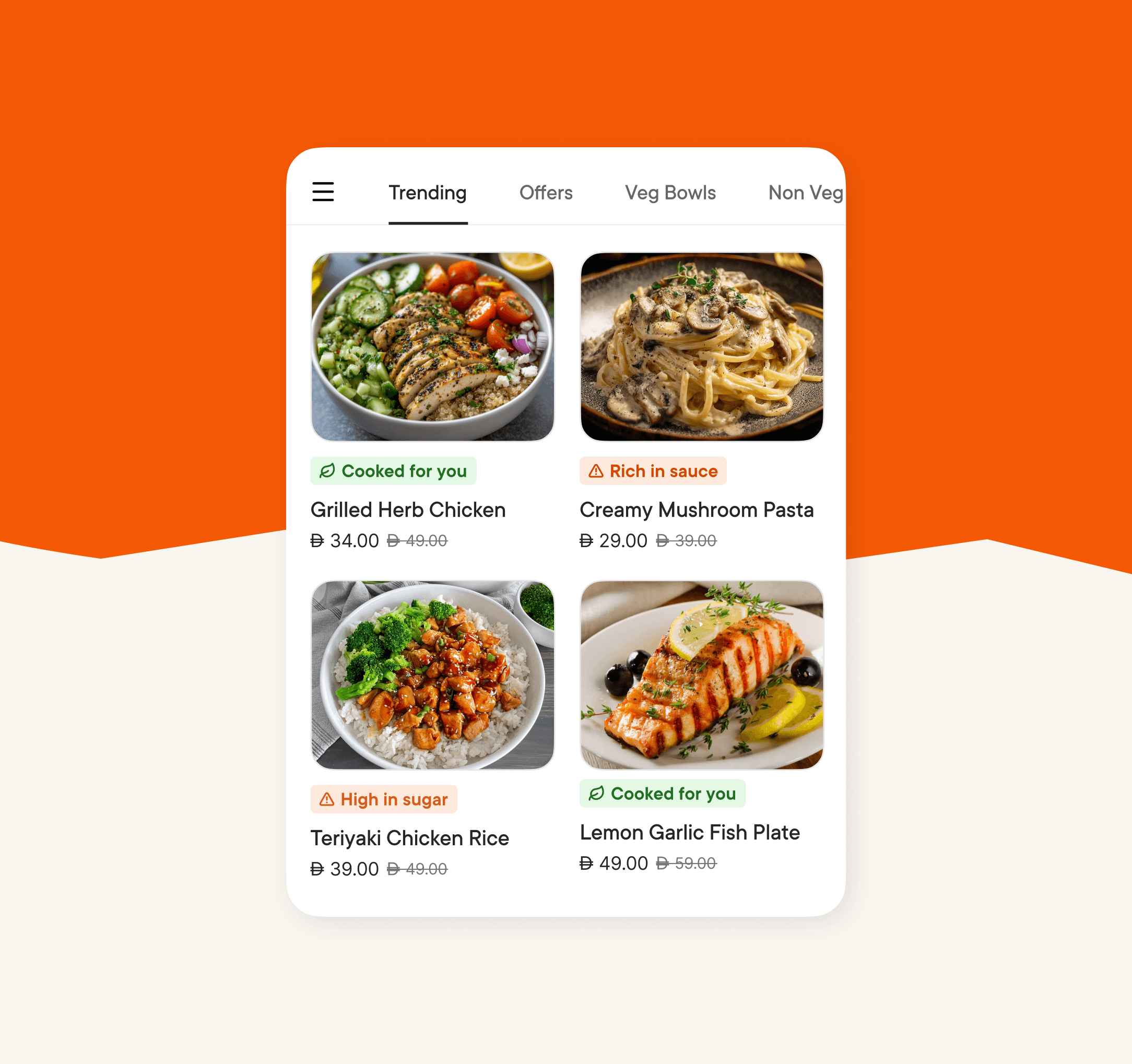
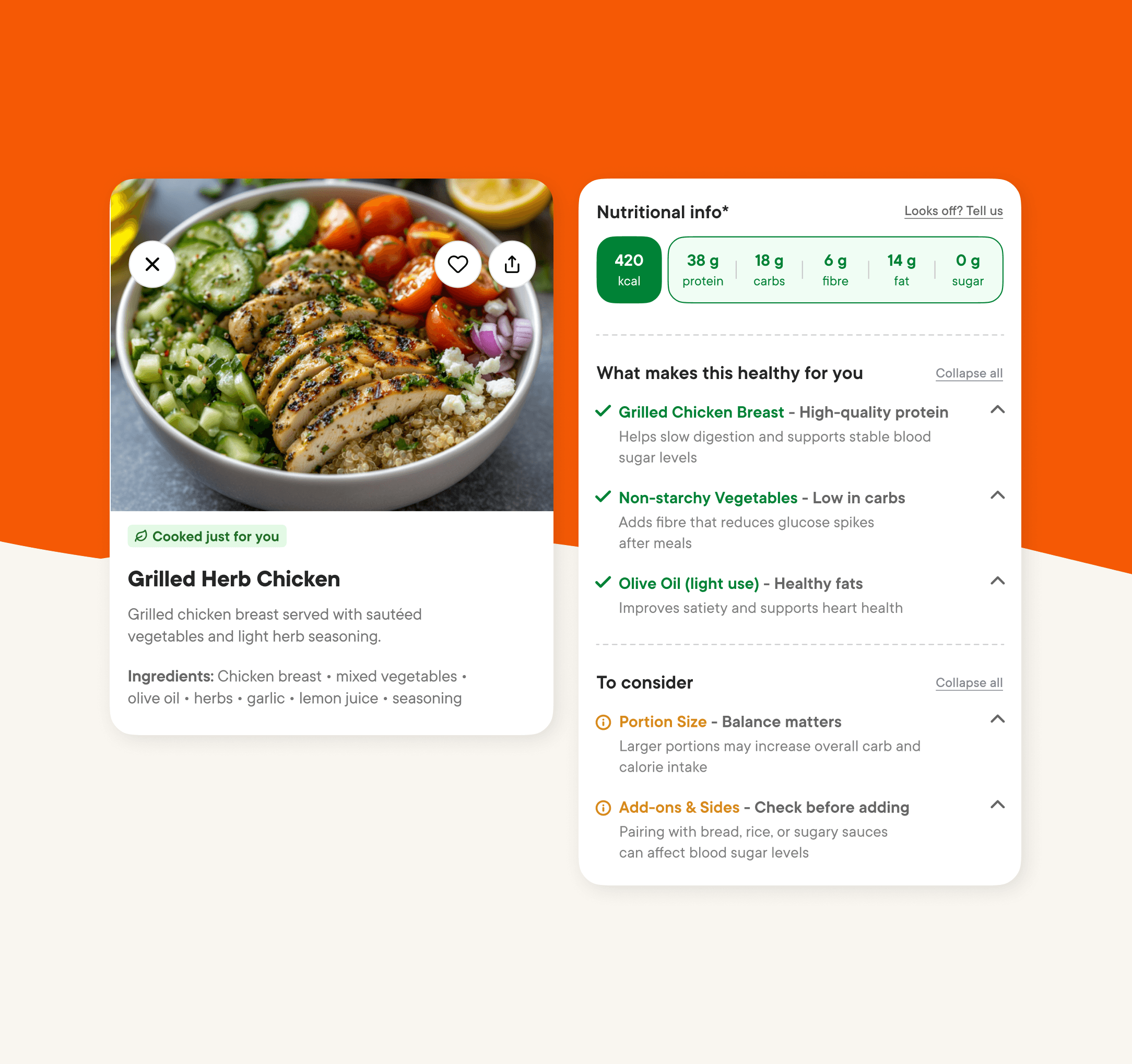
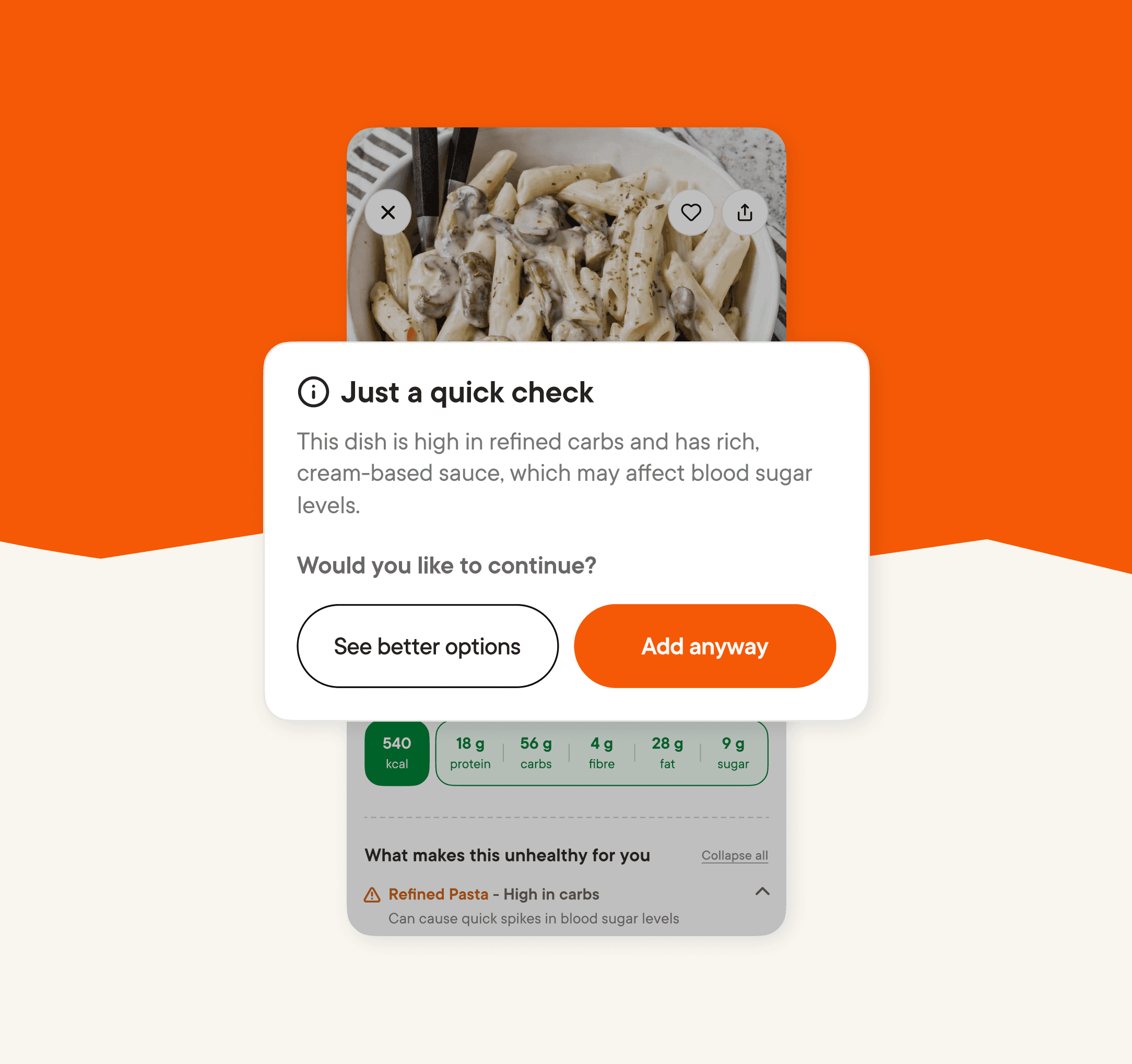
Mapped four core flows: mode activation, health profile setup, dish-level guidance, and pre-checkout warning. Built a full interactive Figma prototype across all four.
Mapped four core flows: mode activation, health profile setup, dish-level guidance, and pre-checkout warning. Built a full interactive Figma prototype across all four.

06 · SOLUTION
a layer of clarity, not a health intervention.
a layer of clarity, not a health intervention.
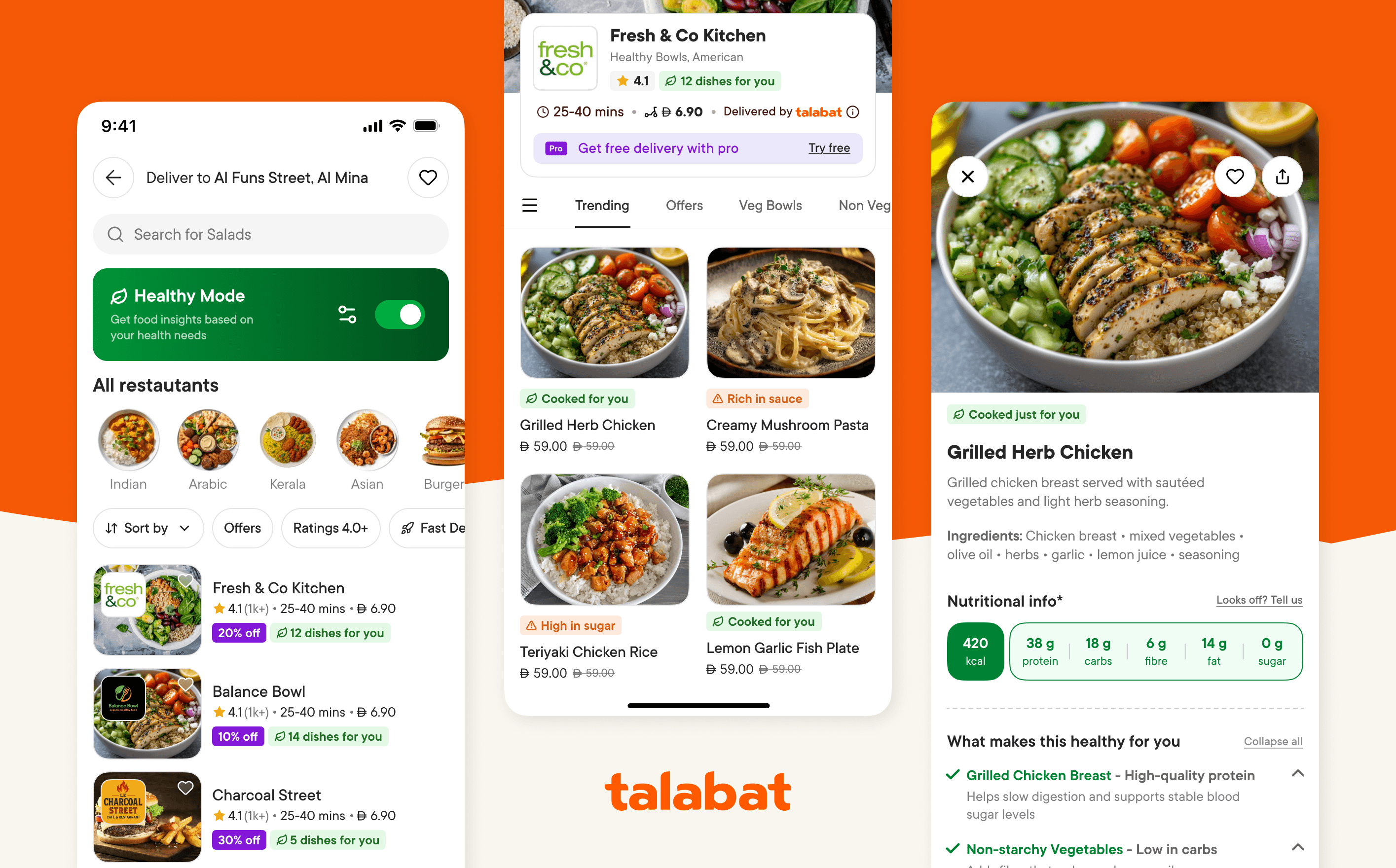
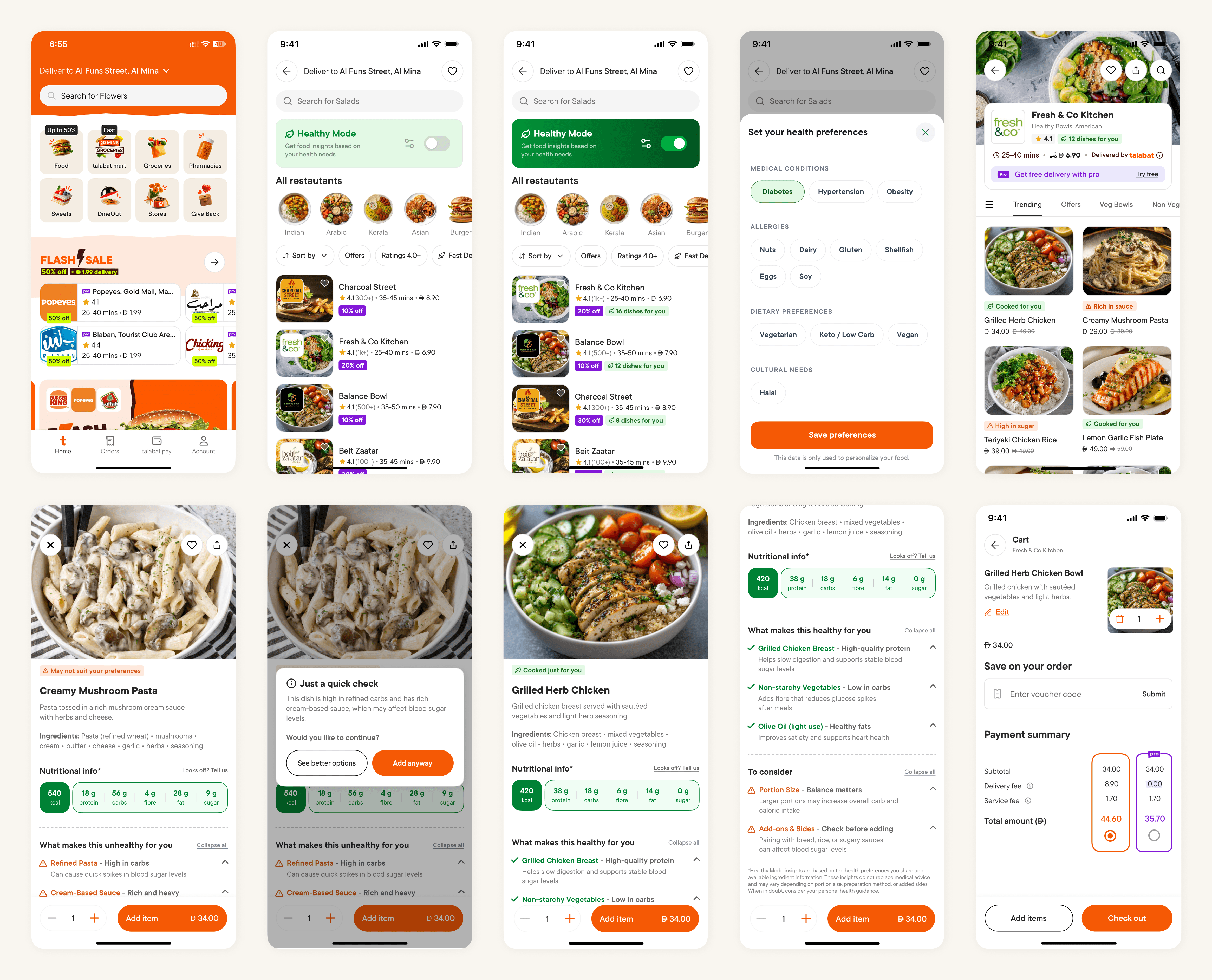
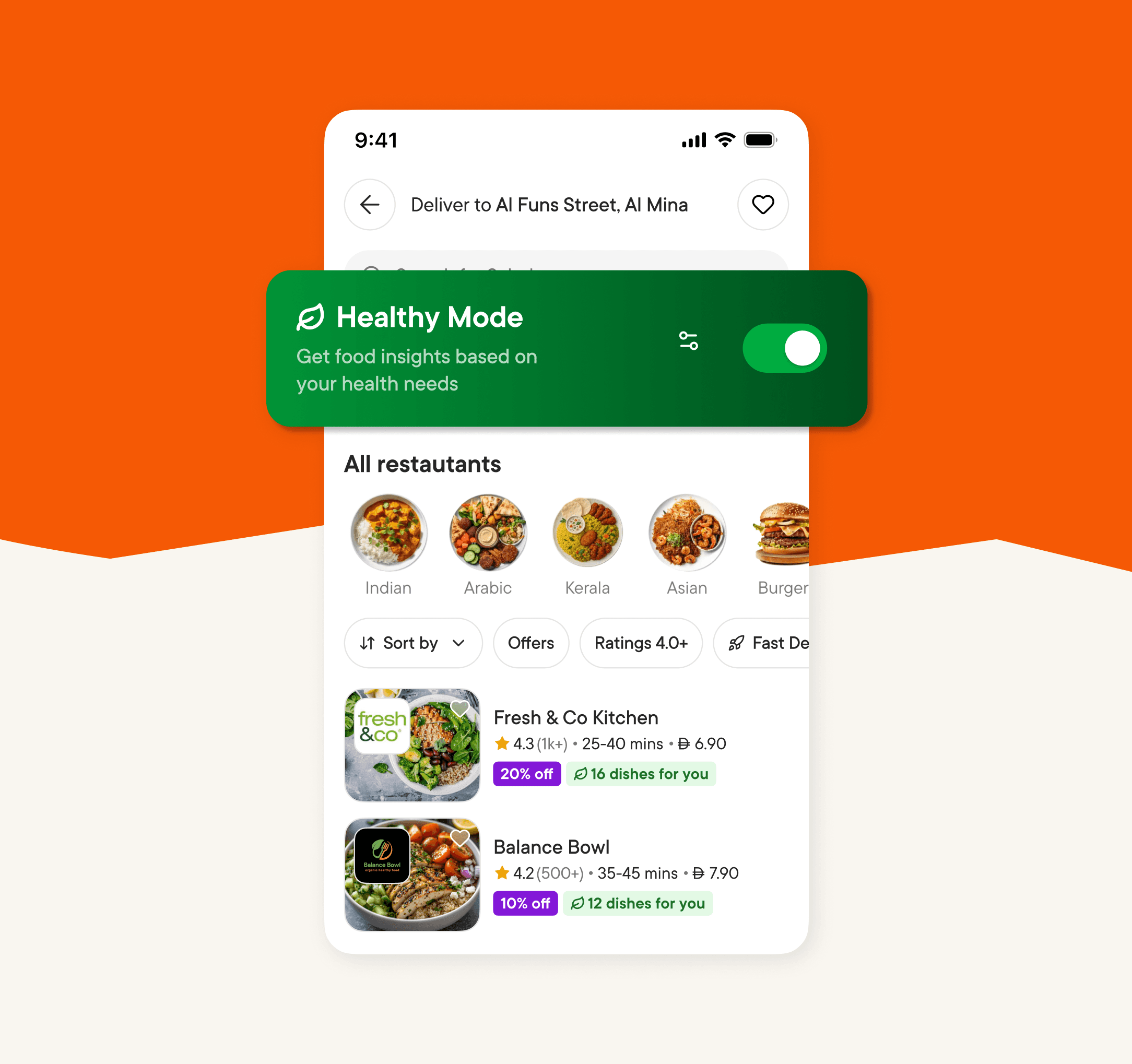
Talabat Healthy Mode is an optional feature that helps users make safer food choices based on their personal health profile. Users set their preferences once. The app surfaces relevant guidance while they browse, without blocking or redirecting their natural ordering flow.
Talabat Healthy Mode is an optional feature that helps users make safer food choices based on their personal health profile. Users set their preferences once. The app surfaces relevant guidance while they browse, without blocking or redirecting their natural ordering flow.
07 · REFLECTION
the insight that drove everything.
the insight that drove everything.
The most impactful design decisions are rarely the most complex ones.
Healthy Mode works because it focuses on the decision point, not the behaviour change. It does not try to make users eat healthy. It removes the uncertainty that stops them from ordering with confidence.
With more time, this concept would be validated with real Talabat users and expanded through confidence scoring, learning from repeat orders, and better restaurant transparency tools.
With more time, this concept would be validated with real Talabat users and expanded through confidence scoring, learning from repeat orders, and better restaurant transparency tools.
Next CASE STUDY · FINTECH
pool money, without losing trust.
pool money, without losing trust.

Maqamy
→
→